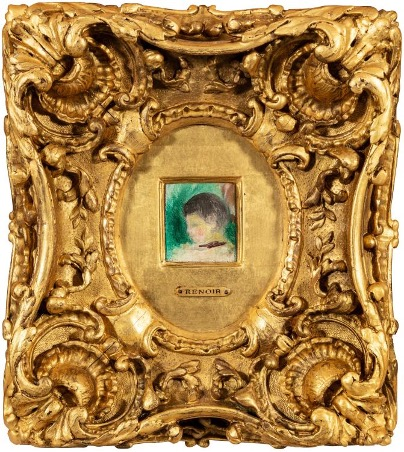
A major headache for important museums within New York City’s gravitational field is that Manhattan’s Big Three – the Metropolitan Museum of Art, the Museum of Modern Art, and the Whitney Museum of American Art – dominate national artworld news. The Newark Museum of Art, the Montclair Art Museum, the Wadsworth Atheneum Museum of Art – all of them have major works in their collections, and all of them mount impressive shows, but to many Manhattan art-lovers, those wonderful institutions are only a vague rumor, somewhere out there in a Saul Steinberg hinterland.
Another member of this under-noticed group of institutions is the New Britain Museum of American Art, located in (where else) New Britain, CT. It has existed in one iteration or another for almost 175 years. The museum’s early decision to concentrate on American art allowed it to acquire major American works at a time when few other museums were doing so, and the collection today includes important works by Childe Hassam, J.H. Twachtman, Mary Cassatt, George Bellows, Georgia O’Keeffe, and Thomas Hart Benton, works which are prominently featured in scholarly books on those artists.
So the museum is well worth a day-trip from Manhattan any time, but if you visit in the next month or so, you’ll be able to see Architects of Being: Louise Nevelson and Esphyr Slobodkina, a first-rate show. Organized by Catherine Walworth of the Arkansas Museum of Fine Arts, this touring exhibition show presents important works by two women artists who had to find their ways in a male-dominated artworld and who pushed through to achieve recognition.
Both were non-observant Jews from Russia who grew up speaking Yiddish. Louise Nevelson (1899-1988) came to Maine with her family in 1905. Her father worked as a woodcutter and later owned a lumberyard, a harbinger of the medium she would make her own. After high school, she went to work as a stenographer and met the scion of a shipping firm whom she married in 1920. They soon moved to New York City, where Nevelson had long wanted to live, and she studied arts as diverse as painting, singing, and acting, studies which were interrupted when she gave birth to a son in 1922.
Nevelson was not pleased when her husband moved the family to suburban Mount Vernon, NY two years later. Her artistic aspirations were frowned on by her in-laws. She later commented, “My husband’s family was terribly refined. Within that circle, you could know Beethoven, but God forbid if you were Beethoven.” Ignoring their concerns, Nevelson began studying full-time at the Art Students League in 1929 and separated from her husband a couple of years later.
Nevelson went to Europe in 1933, where she studied painting with Hans Hofmann and then returned to New York, where she assisted Diego Rivera on his mural for Rockefeller Center. By the mid-1930s, working for the WPA, she had decided to concentrate on sculpture. Gathering discarded wood from the streets at night to burn in her apartment’s stove led her to using wood as her primary medium.
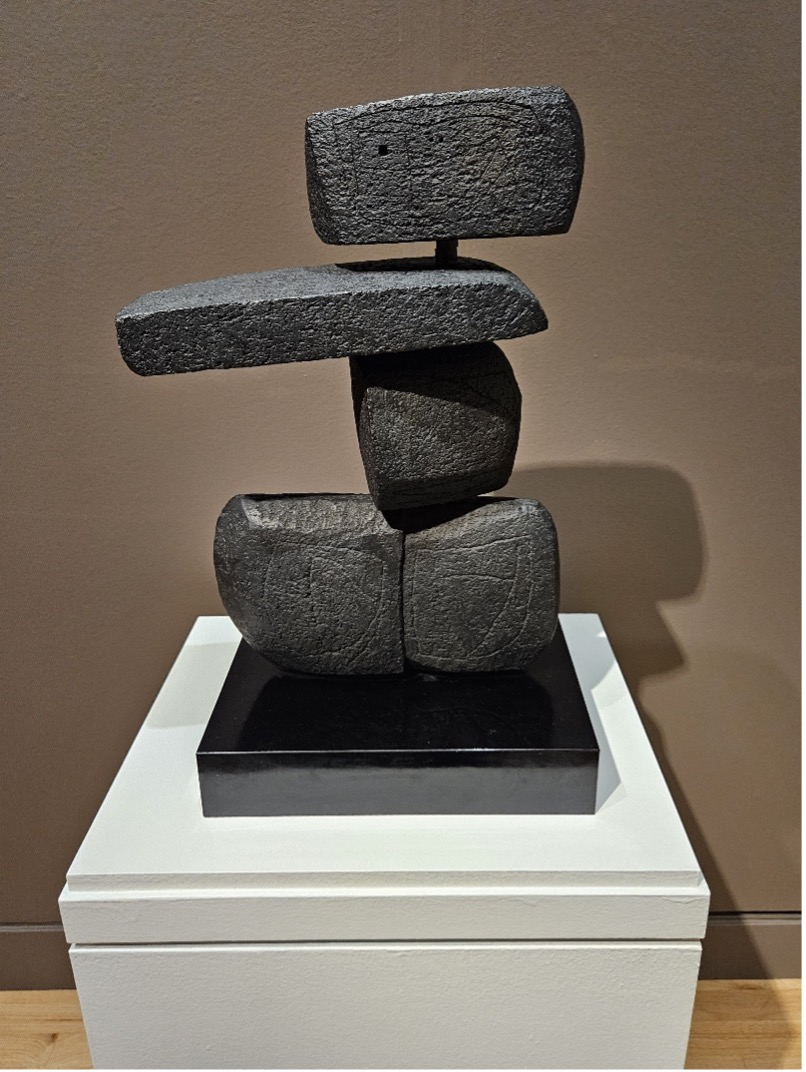
Louise Nevelson, Moving-Static-Moving-Figure, 1947
Terracotta, bronze, wood, paint, and casting
Collection Ulrich Museum of Art, Wichita State University
Her earlier works might be biomorphic in inspiration, but Nevelson soon settled into a boxlike grid format. In an interview for an oral history, she said, “When I found the cube, it stabilized me… I can understand the cube in space.”
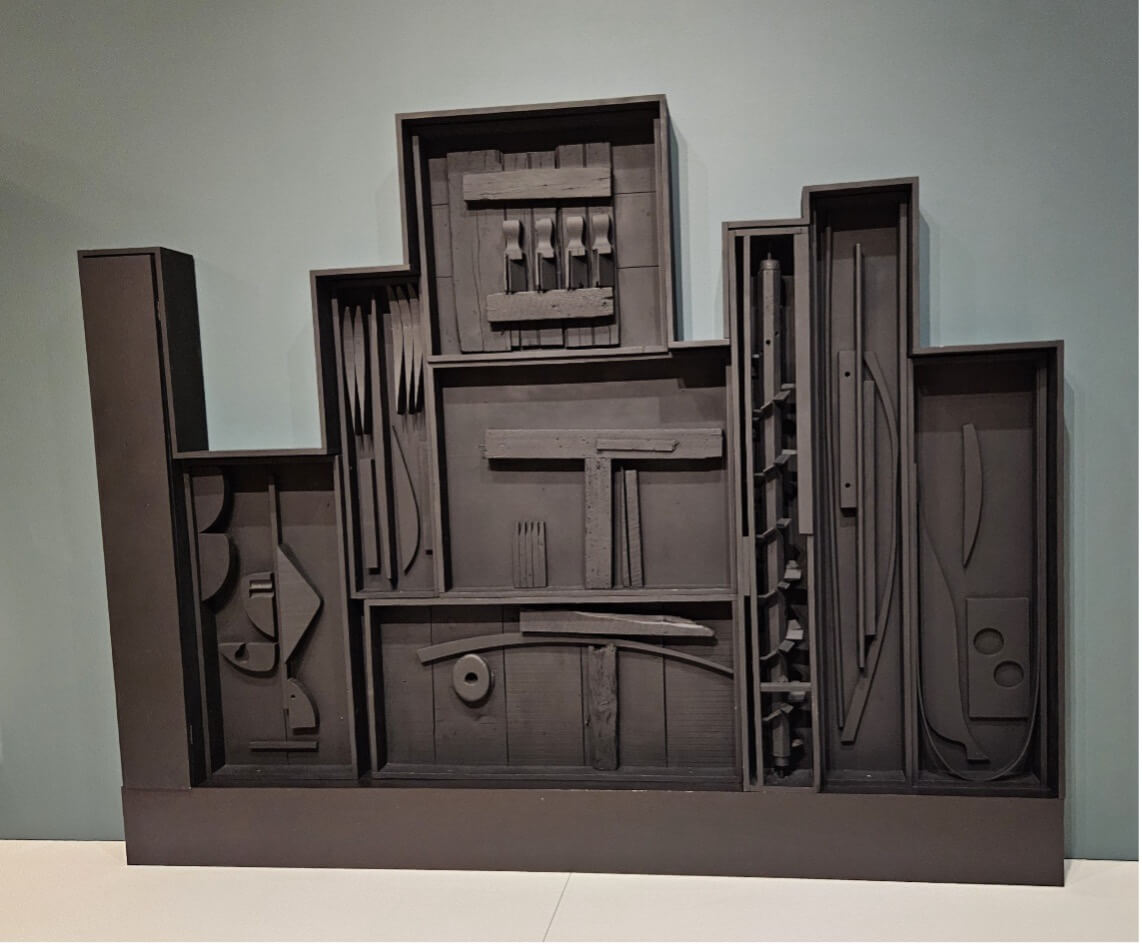
Louise Nevelson, The Tropical Gardens, 1957
Painted wood construction
Collection The Grey Art Museum, New York University
Nevelson’s work appeared regularly in group shows, and she had her first solo show in 1941, but finances were always tight. As late as the mid-1950’s, she had to supplement her income with gigs such as teaching sculpture to adult education classes in the Great Neck, NY school system. An association with Martha Jackson Gallery in 1958 finally gave her some financial security.
Whatever her financial situation, Nevelson always attracted personal attention. She had had couture dresses as the wife of a well-to-do husband, and even as a struggling artist, she wore striking outfits that she had designed herself, including flamboyant headgear. Her colorful persona paid off when she was depicted on the cover of Life Magazine in 1958. By the 1960’s, now at Pace Gallery, her status as a blue-chip contemporary artist was assured and remained so for the rest of her life.
Esphyr Slobodkina (1908-2002) came to the United States by a much more circuitous route. Born in Russian Siberia, she first encountered modern art in the provincial capital of Ufa. When the Russian Revolution broke out in 1917, it was necessary for her family to flee, first to Vladivostok and then to Harbin in Manchuria. Slobodkina’s mother was an accomplished seamstress who taught her skill to her daughters, and the family supported itself in Manchuria by dressmaking. Slobodkina attended high school with aspirations of becoming an architect, but she received private tutoring in painting. During this period, she designed embroidery for her mother’s business.
Times were fraught, however, and members of the family would emigrate to New York over an eight-year period beginning in 1923. Slobodkina’s turn came in 1928. She briefly attended the National Academy of Design while working in a millinery factory. The stock market crash of 1929 reduced their situations, like everyone else’s, but Slobodkina continued her artistic studies. She met a young artist named Ilya Bolotowsky in a drawing class in 1931 and married him two years later. (They later divorced.)
Slobodkina had to work all of her life. Jobs such as one in a textile printing firm added to her design chops. She continued her education in modern art and became fully committed to a cubist-inspired art in the mid-1930’s while working for the WPA. In 1937, along with Bolotowsky and others, she co-founded American Abstract Artists to promote and foster public awareness of non-objective art in the United States. The group picketed the Museum of Modern Art in 1940 to protest what they saw as its indifference to abstract art by American artists.
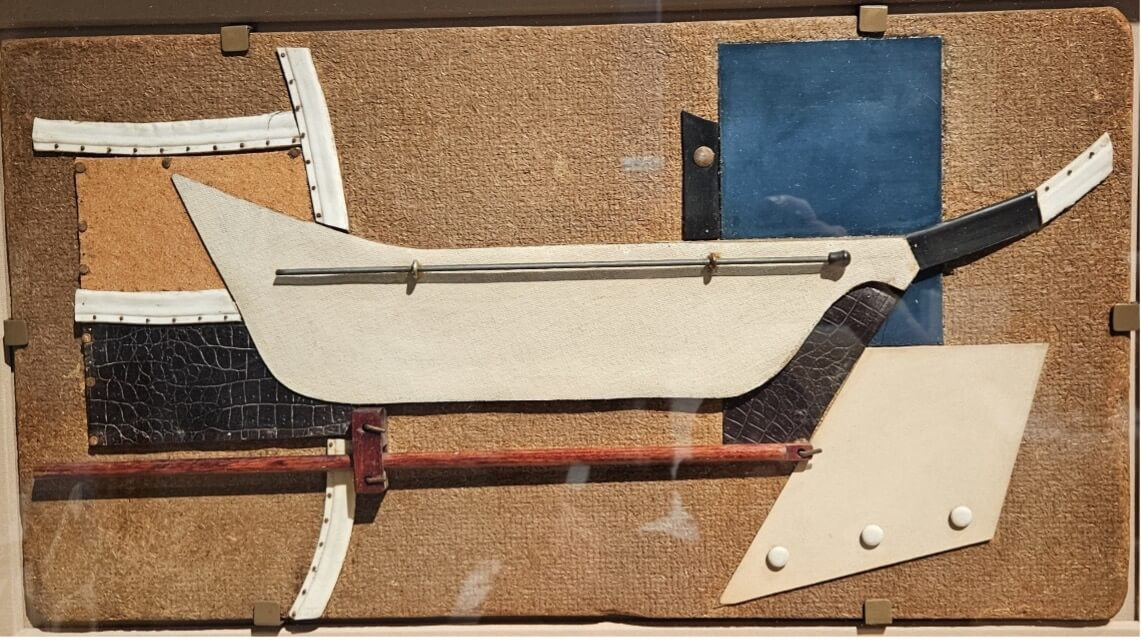
Esphyr Slobodkina, Boat Construction, c. 1937
Mixed-media collage
Collection Arts-Naples, The Baker Museum
A job as an office manager during World War II allowed Slobodkina to save enough money to design and build a house in Great Neck, NY in 1948. She would live there for the rest of her life. Slobodkina had met children’s book author Margaret Wise Brown in 1938. Illustrating books for Brown and other authors and later writing her own books would provide a steady if modest income during the years to come.
Slobodkina participated in the noted show Exhibition by 31 Women at Peggy Guggenheim’s Art of This Century gallery in 1943 (Nevelson was another of the exhibitors). As the title indicates, Slobodkina and the others were pigeonholed – would Guggenheim have titled a show “Exhibition by 31 Men“? Despite the condescension she and other women artists routinely experienced, Slobodkina’s art-making never flagged. She won residencies at prestigious artists’ colonies such as MacDowell and showed whenever possible.
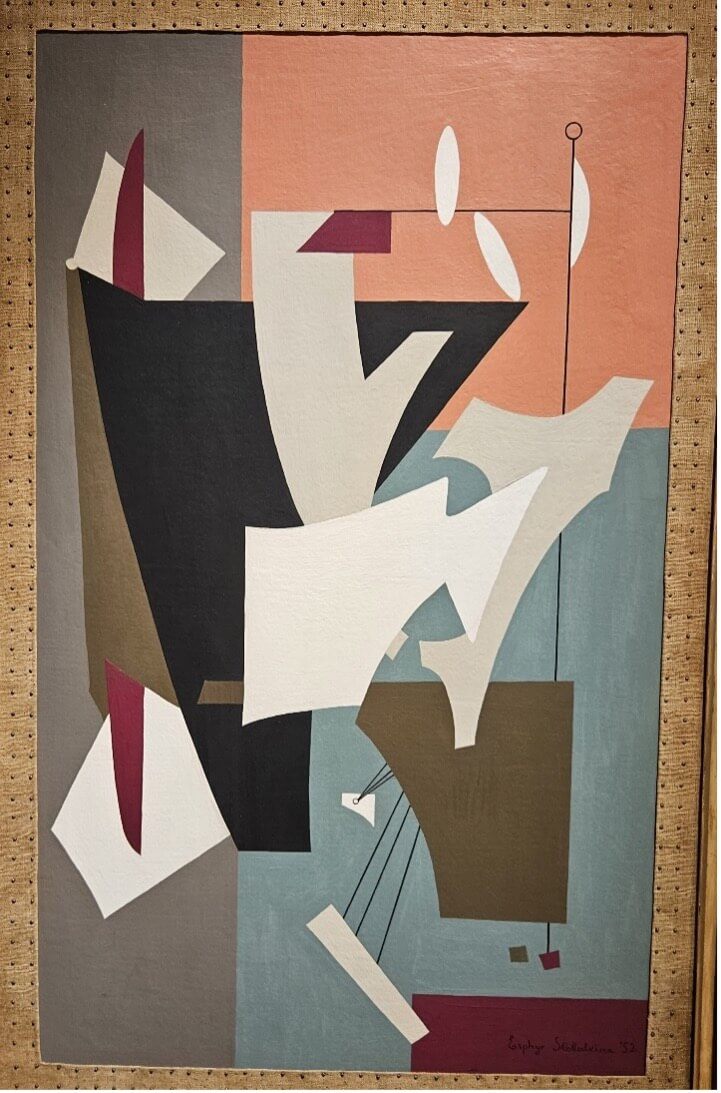
Esphyr Slobodkina, Composition with White Ovals, 1952
Oil, linen, and tacks on composition board
Collection The Whitney Museum of American Art
Like Nevelson, Slobodkina incorporated her aesthetic sense into her daily life, designing dresses (which, unlike Nevelson, she sewed herself), jewelry, and accessories.
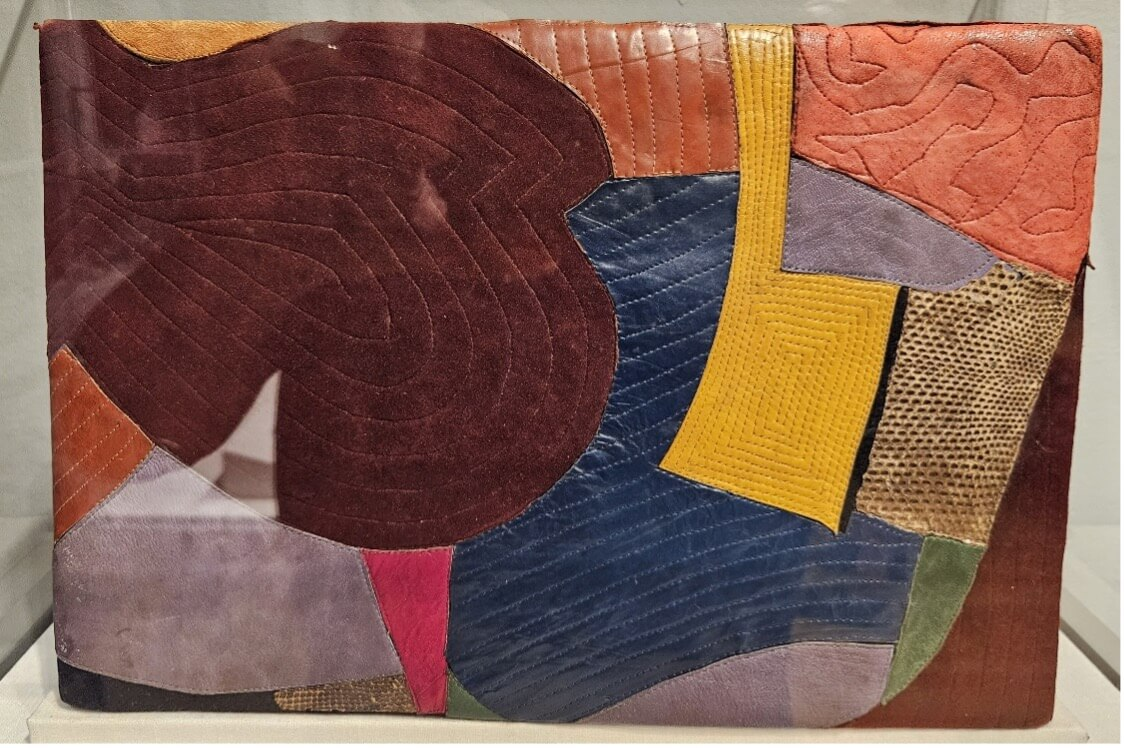
Esphyr Slobodkina, Purse, 1950-53
Felt, repurposed leather, and metal zipper
Collection Slobodkina Foundation
In Architects of Being we see two women artists making their ways in a male-dominated world. I thought about another such artist who had the same challenge: Georgia O’Keeffe, who was the subject of a 2017 exhibition at the Brooklyn Museum, Georgia O’Keeffe: Becoming Modern. That exhibition, in addition to showing O’Keeffe’s paintings, included clothes that she designed and wore as well as other items from her life. In the show, we see O’Keeffe crafting a personal image as well as works of art, or rather, making her own life into a work of art.
I mentioned to Catherine Walworth, the organizer of the Nevelson/Slobodkina show, that her show reminded me of the earlier O’Keeffe exhibition. She enthusiastically agreed.
Walworth has certainly succeeded. We experience what might be termed artists-in-full. While Nevelson, the more flamboyant personality, was better-known, Slobodkina has earned a solid place in the history of American art and beyond American art. If you have children or grandchildren, chances are that you have read the most famous of Slobodkina’s books to them, the story of a peddler and some mischievous monkeys.

I love the fact that in New Britain’s museum shop, along with a scholarly exhibition catalog, you can also purchase a copy of Caps for Sale. Sometimes we lose track of the fact that art is more than “high” art. Architects of Being: Louise Nevelson and Esphyr Slobodkina reminds us that the aesthetic impulse can bring delight in all facets of our lives, from grandparents to two-year-olds.